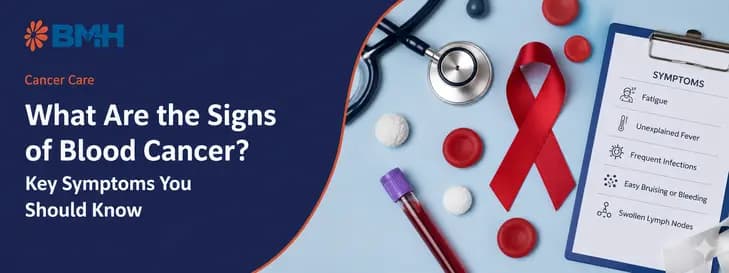

Blood cancers often develop silently, with symptoms such as persistent fatigue, frequent infections, unexplained bruising, or swollen lymph nodes easily mistaken for everyday health issues.
According to the Indian Council of Medical Research (ICMR), blood cancers account for nearly 8% of all new cancer cases in India, with more than 70,000 new diagnoses each year.
Whether you are concerned about your own symptoms or supporting a loved one, recognising the early warning signs can make a significant difference. This guide explains the common symptoms of blood cancer, the major types, when to seek medical evaluation, and the treatment options available in India.
What Is Blood Cancer? (A Simple Explanation)
Blood cancer, clinically termed haematological malignancy, is a group of cancers that attack the body's blood-forming system: the blood cells, bone marrow, and lymphatic system. Unlike solid tumour cancers, there's no detectable lump.
It develops silently, disrupting the normal production of red blood cells, white blood cells, and platelets from within. There are three primary categories under Haemato-Oncology:
-
Leukaemia targets the blood and bone marrow, triggering uncontrolled production of abnormal white blood cells that crowd out healthy cells, leaving the body defenceless against infection.
-
Lymphoma originates in the lymphatic system, attacking lymphocytes (a type of white blood cell). It presents in two forms: Hodgkin lymphoma, identified by a distinct abnormal cell, and Non-Hodgkin lymphoma, a broader and more common group.
-
Multiple Myeloma is a cancer of plasma cells, antibody-producing cells residing in the bone marrow. As malignant plasma cells multiply, they suppress normal blood cell production and weaken bones structurally.
Because blood cancers lack visible tumours, early symptoms; fatigue, frequent infections, unexplained bruising are often dismissed, making timely diagnosis both critical and challenging.
What Are the Signs of Blood Cancer?
Because blood cancer develops from within the bloodstream rather than as a visible mass, its early warning signs are easy to overlook, and easier to misattribute. Here's what to watch for, symptom by symptom.
1. Persistent, Unexplained Fatigue
This isn't the tiredness that follows a long day, it's a bone-deep exhaustion that sleep doesn't fix. It stems from anaemia, as cancerous cells crowd out healthy red blood cells, starving the body of oxygen. Many patients describe it as "feeling heavy all the time" for weeks before any other symptom surfaces. Flag it if fatigue persists beyond 2–3 weeks with no clear cause.
2. Frequent or Recurring Infections
Abnormal white blood cells are functionally defective, they multiply rapidly but cannot fight pathogens effectively, leaving the immune system dangerously compromised. Watch for:
- Repeated throat, chest, or skin infections that keep returning
- A single unusually severe infection, such as pneumonia in an otherwise healthy young adult, which alone can be a significant red flag.
3. Easy Bruising or Unexplained Bleeding
A low platelet count (thrombocytopenia) impairs the blood's ability to clot normally. Visible signs include bruises from minor contact, bleeding gums, frequent nosebleeds, and unusually heavy periods. In leukaemia patients particularly, unexplained bruising is often the first visible symptom that prompts a medical visit.
4. Swollen, Painless Lymph Nodes
Lumps that appear in the neck, armpits, or groin; firm, pea-sized, and notably painless are a hallmark warning sign of lymphoma. The critical distinguisher from infection-related swelling: these nodes do not shrink after 2–4 weeks. If swollen lymph nodes persist without an obvious cause, prompt evaluation is essential.
5. Unexplained Weight Loss
Losing 5–10% of body weight over six months, without any change in diet or activity, is clinically significant. In lymphoma, this forms part of the "B symptoms" cluster, a medically recognised triad of:
- Drenching night sweats
- Persistent unexplained fever
- Significant unintentional weight loss
The presence of B symptoms directly influences staging and treatment decisions.
6. Night Sweats
These are not the mild sweats from a warm room, these drench clothing and bedding, occurring repeatedly through the night. Strongly associated with lymphoma and Chronic Myeloid Leukaemia (CML), they differ from cold or flu sweats in one key way: they persist for weeks without resolving. Combined with other B symptoms, they significantly raise clinical suspicion.
7. Bone and Joint Pain
As cancerous cells accumulate in the bone marrow, they create internal pressure that manifests as deep, aching pain, most commonly in the lower back, ribs, hips, and sternum. This symptom is frequently misdiagnosed as arthritis or a sports injury. In multiple myeloma specifically, bone lesions can weaken the skeleton to the point where minor impacts cause fractures.
8. Shortness of Breath and Chest Pressure
Breathlessness can arise from two distinct mechanisms: enlarged lymph nodes in the chest cavity pressing on the airways, or anaemia reducing the blood's oxygen-carrying capacity. Shortness of breath at rest or from minimal exertion is a medical urgency, do not wait to seek evaluation if this occurs alongside other symptoms on this list.
9. Pale Skin, Yellowing, or Skin Rash
Pallor from anaemia is common, but two more specific signs warrant attention:
- Petechiae: tiny red or purple pinpoint spots on the skin caused by micro-bleeding beneath the surface
- Pruritus: persistent itchy skin without any visible rash, a symptom particularly linked to Hodgkin lymphoma.
10. Abdominal Discomfort, Fullness, or Nausea
An enlarged spleen or liver both commonly affected in blood cancers can press against the stomach, producing a sensation of fullness after eating only small amounts, alongside discomfort or nausea. This subtler symptom is frequently dismissed as a digestive issue, yet it can be one of the earliest internal signs that something more serious is developing.
Although blood cancer affects both men and women, certain symptoms may be experienced, interpreted, or diagnosed differently.
Signs of Blood Cancer in Women vs. Men: Are They Different?
Blood cancer doesn't discriminate by gender, but the way its symptoms are experienced, interpreted, and unfortunately dismissed often does. Understanding these nuances can be the difference between early detection and a delayed diagnosis.
The core symptoms of blood cancer, fatigue, infections, bruising, swollen lymph nodes, remain consistent across both sexes. However, how those symptoms present, and how they're perceived, differs in ways that matter clinically.
For women, two particularly important distinctions stand out:
-
Unusually heavy menstrual bleeding (menorrhagia) can be an early, overlooked indicator of thrombocytopenia, a low platelet count that impairs normal clotting. What seems like a gynaecological issue may in fact be the body's first visible signal of blood cancer.
-
Fatigue: one of the most common early symptoms, is disproportionately attributed to hormonal fluctuation, anaemia from periods, or stress in women, which frequently delays referral to a haematologist by weeks or even months.
For men, the blind spot tends to be physical:
- Bone pain in the lower back, ribs, or hips, a significant symptom of multiple myeloma and leukaemia, is routinely dismissed as occupational strain, a sports injury, or general wear and tear, particularly in physically active or manual labour occupations.
For both, night sweats carry a persistent misattribution problem. In women, they're frequently linked to hormonal changes or perimenopause; in men, to stress or overheating.
The clinical reality is clear: drenching, recurring night sweats that persist beyond a few weeks are not a lifestyle symptom, they are a recognised red flag for lymphoma and CML regardless of age or gender.
The symptoms of blood cancer can change as the disease advances, making it important to recognise both early and later-stage warning signs.


Early Signs vs. Advanced Signs: What Progression Looks Like
Understanding how blood cancer progresses helps contextualise why acting on even mild, persistent symptoms matters. The table below illustrates the typical symptom trajectory, from the earliest, easiest-to-overlook signs through to advanced systemic involvement.
| Stage | Typical Signs |
|---|---|
| Early (Stage 1) | Fatigue, mild anaemia, one swollen lymph node region, minor bruising |
| Intermediate (Stage 2–3) | Multiple swollen lymph node regions, significant weight loss, recurring infections, night sweats |
| Advanced (Stage 4) | Organ involvement (liver, spleen, lungs), severe anaemia, bone damage, systemic B symptoms |
Note: Staging systems vary by cancer type, the Ann Arbor system is used for lymphoma, the RAI system for Chronic Lymphocytic Leukaemia (CLL), and the Durie-Salmon or ISS system for multiple myeloma. This table is illustrative of general progression patterns.
When Should You See a Doctor?
One simple rule guides this decision: if any symptom on this list persists beyond 14 days without a clear explanation, book an appointment, don't wait.
Your doctor's first step will almost certainly be a Complete Blood Count (CBC), a routine, inexpensive blood test that measures red cells, white cells, and platelets, and provides an immediate baseline picture of your blood health.
Can a blood test detect blood cancer? Yes. A CBC is the standard first-line investigation and can flag abnormalities that warrant further specialist review.
Here's the reassurance worth holding onto: the majority of people presenting with these symptoms will not have blood cancer. Fatigue, infections, and swollen glands have many benign explanations.
But ruling out something serious takes a single blood test, it's fast, affordable, and conclusive enough to either act on or set your mind at rest.
Don't wait for certainty. Act on persistence. BMH offers comprehensive cancer screening health care packages for both men and women, welcoming national and international patients with the same standard of diagnostic precision and continuity of care. If any symptom concerns you, book your screening with BMH today and take the first step toward clarity.
How Is Blood Cancer Diagnosed?
Here's exactly what that diagnostic journey looks like, from the first blood draw to molecular confirmation:
Step 1: Complete Blood Count (CBC): The entry point of every investigation. It detects abnormal cell counts, too many, too few, or structurally irregular — and determines whether further testing is warranted.
Step 2: Peripheral Blood Smear: A blood sample is examined under a microscope, allowing clinicians to assess the actual shape, size, and appearance of cells, abnormalities invisible to automated counters become visible here.
Step 3: Bone Marrow Biopsy: The definitive diagnostic test. A small bone marrow aspirate is taken from the hip bone, a procedure that sounds daunting but typically takes just 15–20 minutes under local anaesthesia, with most patients reporting only mild pressure rather than pain.
Step 4: Flow Cytometry and Immunophenotyping: Identifies the precise type and subtype of blood cancer by analysing protein markers on cell surfaces, critical for determining the exact treatment pathway.
Step 5: Imaging (PET-CT, CT, MRI): Determines whether the cancer has spread to lymph nodes, the spleen, liver, or other organs.
Step 6: Cytogenetic and Molecular Testing: Detects chromosomal abnormalities using FISH testing and cytogenetics, including markers like the Philadelphia chromosome in CML, which directly influence prognosis and targeted therapy decisions.
Choosing the right hospital for blood cancer care is as important as the diagnosis itself, and for thousands of patients across India and beyond, that choice has consistently led to one address.
How Baby Memorial Hospital Supports Blood Cancer Diagnosis and Treatment
Baby Memorial Hospital stands as one of South India's most trusted destinations for haematological cancer care, combining specialist expertise, advanced diagnostics, and genuine patient-first values under one roof in Kozhikode. Here's what makes it a genuine alternative to distant metro hospitals.
A Name Trusted Across Kerala and Beyond
BMH has earned its reputation across the Malabar region and internationally, particularly among patients from the Gulf, Africa, and Southeast Asia, as a centre that delivers metro-quality oncology care without the cost or disruption of relocation.
NAVA Cancer Institute: BMH's Dedicated Oncology Centre
At the heart of BMH's cancer care is the NAVA Cancer Institute, a purpose-built, comprehensive oncology centre designed to bring together every dimension of cancer diagnosis, treatment, and rehabilitation under one specialised roof. NAVA represents BMH's institutional commitment to making world-class cancer care accessible in Kerala, eliminating the need for patients to travel to distant metro cities. The institute integrates:
- Medical Oncology and Haematology, full-spectrum blood cancer management
- Surgical Oncology, precision cancer surgery by dedicated oncosurgeons
- Radiation Oncology, advanced radiotherapy planning and delivery
- Bone Marrow Unit, specialised care for transplants and marrow failure syndromes
- Palliative and Supportive Care, dignified, compassionate care at every stage
Specialised Haematology and Oncology Under One Roof
BMH's Department of Medical Oncology and Haematology manages the full blood cancer spectrum, AML, CML, ALL, CLL, Hodgkin and Non-Hodgkin Lymphoma, Multiple Myeloma, MDS, and Bone Marrow Failure Syndromes supported by a dedicated bone marrow unit and advanced diagnostic laboratory.
Patient-Centred Care, Not Just Protocol
Every case at BMH is reviewed by a multidisciplinary tumour board; oncologists, haematologists, radiologists, and pathologists, ensuring every treatment decision is evidence-based, individualised, and clearly communicated to patients and families at every stage.
Have questions about blood cancer symptoms or want to speak with a specialist? Chat with our Medical Team.
Conclusion
Blood cancer doesn't announce itself dramatically. It begins quietly, with fatigue, a bruise, a recurring infection, signals that are easy to dismiss but important never to ignore. The signs are often present long before the disease advances, and early action changes outcomes meaningfully. If something doesn't feel right, trust that instinct. A single blood test can either confirm your concern or put it to rest.
World-class haematological care is closer than you think, book your cancer screening at Baby Memorial Hospital's NAVA Cancer Institute, Kozhikode, today.
You can also Chat with our medical assistant, available 24/7 to guide you to the right specialist at BMH.
Medical Disclaimer The information provided in this article is for educational and informational purposes only. It is not intended to substitute for professional medical advice, diagnosis, or treatment. Always consult a qualified healthcare provider, such as a haematologist or oncologist, if you are experiencing any of the symptoms described in this article. Baby Memorial Hospital's content team works with qualified medical professionals to ensure accuracy, but individual health situations vary. Do not delay seeking medical attention based on anything you have read here.