
Pancreatic cancer is one of the most serious forms of cancer, and Whipple surgery, also called pancreaticoduodenectomy, remains one of the most effective surgical treatments available. If you or a loved one has been diagnosed with pancreatic cancer, understanding this major operation can help you prepare emotionally and physically for what lies ahead.
This guide walks through what the Whipple procedure actually involves, who qualifies, what recovery really looks like week by week, what it costs in India, and the honest risks nobody should gloss over, along with how a structured hospital pathway, like the one at NAVA Cancer Institute at Baby Memorial Hospital (BMH), Kozhikode, approaches the decision..
What Is Whipple Surgery (Pancreaticoduodenectomy)?
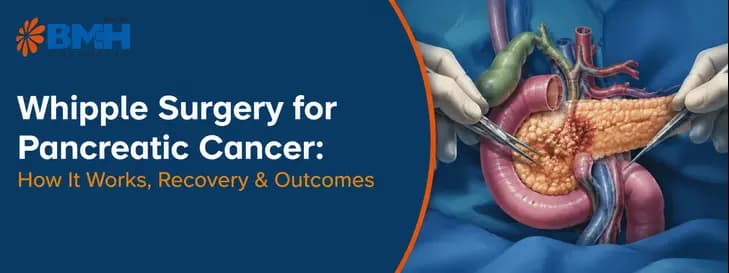
Whipple surgery, medically known as a pancreaticoduodenectomy, is the most commonly performed operation for cancer located in the head of the pancreas, the wider end of the organ that sits closest to the small intestine.
During the procedure, the surgeon removes the head of the pancreas, the gallbladder, part of the bile duct, the duodenum (the first section of the small intestine), and nearby lymph nodes. In some cases, a portion of the stomach is removed as well.
Once the diseased tissue is out, the remaining pancreas, bile duct, and stomach are reconnected to the small intestine so digestion can continue.
What makes this operation technically demanding isn't just what's removed, it's what has to be rebuilt. The pancreas sits behind major blood vessels supplying the liver and intestines, and the reconstruction has to route bile, pancreatic enzymes, and food through new connections that must heal without leaking.
That's a big part of why the operation typically takes several hours and why the volume and experience of the surgical team performing it has a measurable effect on outcomes, a pattern that's been consistently documented across HPB surgery literature, not unique to any one hospital.
Who Is Actually a Candidate for Whipple Surgery?
This is the question that matters most, and it's also the one most generic health articles skip past. Not every pancreatic cancer diagnosis leads to a surgery conversation. Only around 20% of pancreatic cancer patients turn out to be medically eligible for resection, because pancreatic tumours are frequently diagnosed only after they've grown into nearby blood vessels or spread beyond the organ.
Staging is what decides this, and it typically falls into three categories:
-
Resectable: The tumour is confined to the pancreas with no involvement of major blood vessels. Surgery is usually offered as the first step.
-
Borderline resectable: The tumour touches or slightly involves nearby vessels. Many centres now use "neoadjuvant" chemotherapy first, to shrink the tumour before attempting surgery.
-
Locally advanced or metastatic: The tumour has grown around major vessels or spread to other organs. Surgery is generally not curative at this stage, and systemic treatment becomes the primary approach.
In practice, this decision is never made by imaging alone or by a single surgeon's judgment. At NAVA Cancer Institute, every suspected pancreatic head tumour is reviewed by a multidisciplinary hepatobiliary (HPB) tumour board, a joint discussion between the HPB surgeon, medical oncologist, radiologist, and pathologist that looks at the scans, biopsy, and the patient's overall fitness for major surgery together, before anyone commits to an operation date.
This matters practically: a patient who is technically "resectable" but has poor nutritional status or uncontrolled jaundice may need biliary drainage and nutritional optimisation first, or the surgery risk profile changes substantially.
Also Read: Early Signs and Symptoms of Pancreatic Cancer: A Complete Guide
Open vs. Laparoscopic vs. Robotic Whipple: How the Techniques Compare
The Whipple procedure can be performed using different surgical approaches, and the choice depends on the tumour’s location and extent, the patient’s overall condition, and the surgical team’s expertise. Here’s how the three approaches generally compare:
| Approach | Incision | Typical Hospital Stay | Best Suited For |
|---|---|---|---|
| Open Whipple | Single large abdominal incision | 8–12 days | Larger or vascular-involved tumours, complex anatomy |
| Laparoscopic Whipple | Several small incisions | 7–10 days | Selected early-stage, favourable anatomy |
| Robotic-Assisted Whipple | Small incisions, robotic instrumentation | 7–9 days | Precision reconstruction in experienced high-volume centres |
What Happens Before, During, and After Surgery
A Whipple procedure involves careful preparation before the operation, a complex surgical process, and close monitoring during recovery. Here’s what patients can generally expect at each stage:
1. Before surgery
Staging scans (CT or MRI, sometimes PET-CT), a biopsy to confirm tissue type, and blood work to assess organ function. If the bile duct is blocked and the patient is jaundiced, a stent is often placed endoscopically to relieve this before surgery. Nutritional counselling in the weeks before surgery has a real effect on how well a patient tolerates the operation and recovers afterward, this is one of the most under-discussed parts of pre-op planning.
2. During surgery
The operation generally runs 5 to 8 hours. After the head of the pancreas, duodenum, gallbladder, and part of the bile duct are removed, the surgeon reconstructs three separate connections, pancreas to intestine, bile duct to intestine, and stomach to intestine, so digestion, bile flow, and enzyme delivery can resume.
Recovery, realistically, by timeframe:
| Timeframe | What to Expect |
|---|---|
| Days 1–3 | ICU or high-dependency monitoring, IV nutrition, pain management, early mobilisation |
| Days 4–7 | Transition to liquid then soft diet, drains monitored and gradually removed |
| Days 7–10 | Typical discharge window if recovery is on track |
| Weeks 2–6 | Gradual return to regular diet, fatigue is common, physiotherapy support helps rebuild strength |
| Months 2–3 | Most patients resume normal activity; some require pancreatic enzyme supplements long-term |
BMH's standard post-Whipple pathway keeps patients in hospital for 7 to 10 days depending on individual recovery, with physiotherapy and nutritional support built into that window rather than added on request.


Risks and Complications: An Honest Look
No article about this surgery is complete, or trustworthy, without naming the risks plainly. Whipple surgery is a major operation, and complications are not rare:
-
Delayed gastric emptying: The stomach takes longer than normal to empty after eating; usually resolves within 7–10 days but occasionally requires temporary tube feeding.
-
Pancreatic fistula (leak): Leakage at the pancreas-to-intestine connection, occurring in roughly 1 in 10 patients, typically managed with drains and antibiotics (Pancreatic Cancer Action Network).
-
Bleeding or infection, both at the incision site and internally.
-
Diabetes, short- or long-term, since part of the pancreas's insulin-producing tissue is removed.
-
Digestive changes, including the need for pancreatic enzyme supplements to help absorb fat and nutrients.
The point of listing these isn't to discourage the surgery, for eligible patients, it remains the only route to potential cure. It's to make clear that recovery quality depends heavily on the experience of the surgical and post-operative team, which is exactly why hospital and surgeon volume is worth asking about directly when you're choosing where to have this done.
Survival Outcomes After Whipple Surgery for Pancreatic Cancer
Survival numbers for pancreatic cancer are sobering, but they change dramatically with stage at diagnosis. According to India's ICMR Consensus Document data, patients with localized, resectable disease who undergo curative surgery have a 5-year survival rate of around 22%, compared to just 2% for patients diagnosed with distant, metastatic disease.
That tenfold difference is the clearest argument for early detection and prompt referral to a surgical HPB team the moment a pancreatic mass is suspected, waiting rarely improves the odds.
What Does Whipple Surgery Cost in India?
Cost is one of the most searched, and most avoided, questions in this space, so here it is directly. Whipple surgery in India typically costs between roughly ₹3 lakh and ₹9 lakh (about $3,600–$10,800), depending on the hospital, city, surgical technique (open, laparoscopic, or robotic), and length of ICU/hospital stay.
For comparison, the same procedure commonly costs upward of $100,000 in the US or UK, which is a large part of why India, and Kerala specifically, with its established medical tourism infrastructure, sees a steady flow of international patients for HPB surgery.
Factors that move the price within that range include:
- Open vs. minimally invasive (laparoscopic/robotic) technique
- Length of ICU stay and any complications requiring extended care
- Room category selected
- Need for pre-op biliary drainage or nutritional stabilisation
- Post-surgical chemotherapy, which is billed separately from the surgery itself
At BMH, cost estimates are only given after the tumour board has reviewed imaging and staging, not as a flat quote before anyone has actually looked at the case, because the technique, ICU needs, and length of stay genuinely vary from patient to patient.
Why Patients Choose NAVA Cancer Institute at Baby Memorial Hospital for Pancreatic Cancer Surgery
Pancreatic cancer surgery is rarely the work of a single specialist. Accurate imaging, pathology, HPB surgery, oncology and critical care all need to work together to determine whether surgery is appropriate and how it should be performed.
At NAVA Cancer Institute, Baby Memorial Hospital (BMH), Kozhikode, these services are integrated within a multidisciplinary cancer-care model. Patients can benefit from coordinated evaluation and tumour-board discussions before major surgery is recommended.
What Patients Can Expect
-
Multidisciplinary evaluation: Cases can be reviewed by surgical oncology, medical oncology, radiology, pathology and other relevant specialists.
-
HPB surgical expertise: The surgical team assesses tumour location, blood-vessel involvement and overall operability before planning the procedure.
-
Advanced cancer care: Imaging, oncology, surgery and critical care are coordinated within the hospital.
-
Structured postoperative care: ICU monitoring and follow-up are important after complex pancreatic procedures such as the Whipple procedure.
-
Support for outstation patients: Patients travelling from across Kerala, other parts of India and abroad can access coordinated support for treatment and hospital logistics.
For families considering pancreatic cancer surgery, the key question is not simply whether a hospital performs the Whipple procedure, but whether the right specialists are involved before, during and after surgery. At NAVA Cancer Institute, the multidisciplinary approach is designed to provide that continuity of care.
Conclusion
Whipple surgery remains the only realistic path to long-term survival for pancreatic head cancer, but it is not a decision to make in isolation, and it is not right for every patient. If a pancreatic mass has been found, yours or a family member's, the single most useful next step is getting it reviewed by a multidisciplinary HPB team quickly, so that if surgery is an option, it isn't missed while time passes.
Every pancreatic cancer diagnosis looks different on a scan. Chat with our care assistant to get help understanding your reports and connecting with the HPB oncology team at NAVA Cancer Institute, Baby Memorial Hospital.
Medical Disclaimer: This article is intended for general informational purposes only and does not constitute medical advice. Whipple surgery eligibility, technique, risks, and outcomes vary significantly by individual case and can only be determined through consultation and evaluation by a qualified multidisciplinary medical team. Please consult a qualified oncologist or HPB surgeon for diagnosis and personalised treatment recommendations.