
When a cancer diagnosis lands, the questions that follow are rarely about biology first, they're logistical. Where do I go? Who operates? What will it cost, and how long will I actually be away from my life? For patients in Kozhikode and the wider Malabar region, one part of that question has quietly changed in the last few years: advanced robotic cancer surgery is no longer something you travel to Kochi, Chennai, or Bangalore for.
Kozhikode now has more than one hospital offering da Vinci robotic-assisted cancer surgery. But "available" and "right for you" are two different questions, and most articles on this topic answer neither with much local specificity. This one tries to.
What "Robotic Cancer Surgery" Actually Means, Briefly
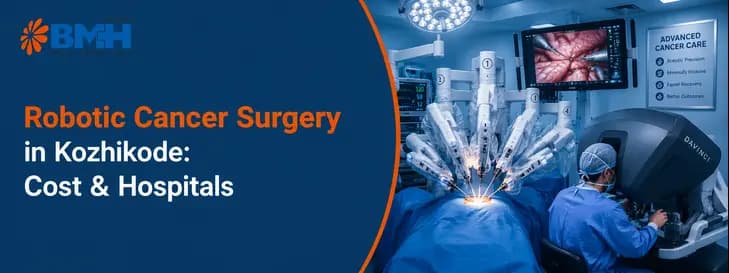
Robotic cancer surgery uses a surgeon-controlled platform, almost always the da Vinci Surgical System in India, where the surgeon operates from a console a few feet from the patient, guiding robotic arms through small keyhole incisions.
The system doesn't operate independently; it translates the surgeon's own hand movements into smaller, steadier, more precise motions inside the body, with a 3D magnified view that standard laparoscopy doesn't offer.
If you want the full technical breakdown of how the system works and which cancers it treats across Kerala, that's covered in depth in our companion guide, Da Vinci Robotic Cancer Surgery in Kerala. This article stays focused on one question: what does this look like specifically in Kozhikode?
Is Robotic Cancer Surgery Available in Kozhikode? Yes, Here's the Landscape
Kozhikode's robotic surgery landscape has more than one name in it, and a good decision starts with knowing that.
Baby Memorial Hospital (BMH) operates a Da Vinci robotic platform through its Advanced Robotic & Laser Urology Centre, but the more relevant fact for a cancer patient is where that platform sits: inside NAVA Cancer Institute, a dedicated, integrated cancer centre launched at BMH's Kozhikode campus in February 2026.
The distinction matters because a robotic procedure for cancer is rarely just a surgery, it involves staging scans, a multidisciplinary review, the operation itself, and often follow-up radiation or systemic therapy. Whether all of that happens on one campus, coordinated by one team, is often a bigger factor in outcomes and patient experience than the robot itself.
Nonetheless, MVR Cancer Centre & Research Institute, in the wider Kozhikode district, has also signalled robotic surgery as part of its roadmap as a stand-alone cancer centre.
Naming the hospital that had the technology first isn't a detail to gloss over, it's a trust signal, and patients researching this decision deserve the accurate timeline. What should actually drive the choice is a different question, covered further down.
Benefits of Robotic Cancer Surgery
The benefits of robotic cancer surgery go well beyond the operating room. By using tiny incisions and highly precise robotic instruments, surgeons can perform complex cancer procedures with less disruption to surrounding healthy tissue. For many patients, this translates into a smoother recovery, fewer complications, and an earlier return to daily life, while maintaining cancer treatment outcomes comparable to conventional surgery when performed for appropriate cases.
Key benefits include:
-
Less post-operative pain: Smaller incisions generally cause less tissue trauma, reducing pain after surgery and often decreasing the need for opioid pain medications.
-
Lower risk of infection: Minimal incisions expose less tissue, which can reduce the likelihood of surgical site infections and other wound-related complications.
-
Faster wound healing: Most robotic surgery incisions heal within 1–2 weeks, compared with the longer healing period commonly associated with open procedures.
-
Shorter recovery time: Many patients are able to resume walking, light physical activity, and even return to work within 2–4 weeks, whereas recovery after open surgery may take 6–8 weeks, depending on the procedure and individual health.
-
Improved surgical precision: High-definition, magnified 3D visualization and wristed robotic instruments enable surgeons to work accurately in confined spaces, helping them identify tumor boundaries and surrounding anatomy more clearly.
-
Better preservation of healthy tissues: Enhanced precision may help protect important nerves, blood vessels, and organs located close to the tumor. This is particularly valuable in cancers involving the prostate, rectum, head and neck, and gynecologic organs.
-
Comparable cancer outcomes: Current evidence shows that, for appropriately selected patients and procedures, robotic cancer surgery provides long-term cancer control and survival outcomes comparable to open surgery, while offering several recovery-related advantages.
-
Suitable for selected high-risk patients: Because robotic surgery is minimally invasive, some patients with multiple medical conditions may tolerate the procedure better than traditional open surgery, although eligibility depends on the cancer type, stage, and overall health.
It's important to note that robotic surgery is not automatically the best option for every cancer or every patient. The choice depends on factors such as the type and stage of cancer, tumor location, the patient's overall health, and the experience of the surgical team.
Which Cancers Are Being Treated Robotically in Kozhikode Right Now
Across Kozhikode's robotic programmes, the most common applications mirror the national pattern:
-
Prostate cancer (robotic radical prostatectomy): The most frequently performed robotic oncological procedure, valued for nerve-sparing precision near the urinary and sexual function nerves. BMH's urology team recently completed four advanced robotic prostate procedures in a short span, an indicator of active surgical volume rather than occasional use.
-
Kidney cancer (partial or radical nephrectomy), preserving healthy kidney tissue where possible.
-
Bladder cancer (radical cystectomy), including intracorporeal reconstruction in select cases.
-
Colorectal cancer, where the confined space of the pelvis benefits from the robotic system's range of motion.
-
Gynaecological cancers, endometrial, cervical, and ovarian, where robotic hysterectomy typically means less blood loss and a faster return home than open surgery


What Does Robotic Cancer Surgery Cost in Kozhikode?
Cost is usually the second question after "where," and it's rarely answered with real numbers. Nationally, robotic surgery in India ranges from roughly INR 1.5 lakh to INR 11 lakh, depending on the procedure, hospital, and length of stay. For context on why patients, particularly from the Gulf, travel for this: robotic prostatectomy starts from around $9,000 in India, compared to $34,720 in the United States.
Locally in Kozhikode, package pricing varies by hospital, cancer type, and stage, and by whether ICU days or additional imaging are bundled in. The practical advice that applies regardless of hospital: ask for a written cost estimate broken down by surgery, hospital stay, and any post-operative therapy, rather than relying on a verbal ballpark during a first consultation.
Why Choose Robotic Surgery in Kozhikode and Region
Kozhikode and the surrounding region, including Kannur, Thodupuzha, Payyanur, and Vadakara, are home to leading oncology centers equipped with state-of-the-art robotic surgical platforms and staffed by experienced surgical oncologists.
Choosing local care offers significant advantages: you avoid the stress and expense of traveling to distant cities, your family can be nearby during surgery and recovery, and you maintain continuity of care with your local medical team. Many patients also value receiving advanced cancer treatment close to home without sacrificing the quality that comes from specialized, high-volume centers.
These centers provide integrated care, combining robotic surgery with medical oncology, radiation therapy, and supportive services, ensuring comprehensive cancer management. Surgeons in Kozhikode and nearby areas have built expertise across multiple cancer types and routinely perform robotic procedures, maintaining the high case volumes associated with better outcomes.
Additionally, costs are often more reasonable than traveling to metropolitan centers while maintaining world-class standards. For international patients seeking advanced oncology care, Kozhikode's growing reputation and accessibility make it an increasingly attractive destination. The combination of experienced surgeons, advanced technology, and patient-centered care makes this region an excellent choice for cancer surgery.
So Is BMH Really the Right Choice in Kozhikode? Let's Talk Honestly
If you're reading this while actually deciding, here's a straight answer rather than a sales pitch.
So what's BMH's actual case? It's less about the robot and more about what surrounds it. NAVA Cancer Institute, launched at BMH's Kozhikode campus in February 2026, was built as a structured cancer programme, every complex case goes through a multidisciplinary tumour board of surgical, medical, and radiation oncologists before a treatment path, robotic or otherwise, is decided.
The robotic urology team trains through a partnership with Aesculap Academy in Germany, an externally benchmarked training standard that not every robotic programme in India has.
And in 2026, BMH was ranked among India's best hospitals in the Newsweek World's Best Hospitals list, published with Statista, which evaluated over 2,500 hospitals across 32 countries using independent methodology, not self-reported claims.
Does that make it "the best" for everyone?
No single hospital is the right fit for every patient, that depends on your specific cancer, its stage, and what your treating oncologist recommends after reviewing your reports.
What BMH can offer is a NABH-accredited, 38-year-old institution where staging imaging (PET-CT, dual 1.5T MRI), robotic surgery, radiation (TrueBeam LINAC), and follow-up care sit on one campus, coordinated by one team, which matters for continuity, particularly for patients travelling from other states or abroad who can't easily shuttle between three different facilities for three different parts of treatment.
Is it affordable relative to international options?
For Gulf-based and other international patients, BMH's international patient desk provides pre-arrival case review and written cost guidance, medical visa assistance, and on-ground support, priced well below equivalent robotic cancer surgery in the Gulf, US, or UK, while remaining transparent about what's included.
If that combination, integrated care, external training benchmarks, independent hospital ranking, matters more to you than "who had the technology first," that's the honest basis for considering BMH. If it doesn't, the checklist below applies regardless of which hospital you choose.
Conclusion
Robotic cancer surgery is no longer a reason for patients in Kozhikode to travel to a metro city, it's available locally, across more than one hospital, with real cost transparency and recovery advantages over open surgery. The harder, more useful question isn't "does Kozhikode have robotic surgery" (it does), but which programme fits your specific diagnosis, budget, and need for integrated, coordinated care.
Whichever hospital you're evaluating, the checklist above, not marketing language, should guide the decision. And that decision starts with a clinical case review, not a commitment.
Chat with our Medical Assistant. Get instant help understanding your treatment options, cost estimates, and travel planning for robotic cancer surgery at BMH Kozhikode. Available 24×7 in 8+ languages.
Medical Disclaimer: This article is for informational purposes only and does not constitute medical advice, a diagnosis, or a treatment recommendation. Whether robotic surgery is appropriate for a specific patient depends entirely on individual factors — cancer type, stage, anatomy, overall health, and tumour biology. Always consult a qualified oncologist or surgical specialist before making any treatment decision. Statistics referenced in this article are drawn from cited third-party sources current as of publication; individual outcomes and costs may vary, and hospitals should be contacted directly for current pricing. International patients should consult their treating physician at home before travelling for treatment.