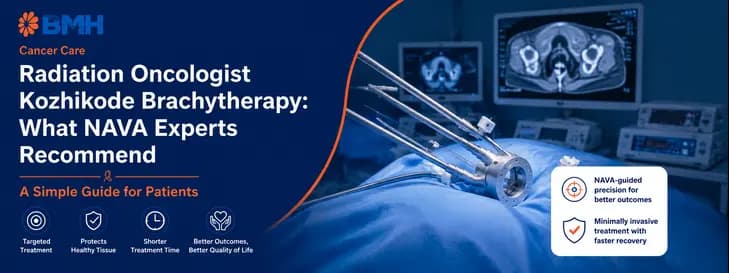

A cancer diagnosis often brings families in search of the right specialist and treatment approach. A patient from Malappuram, for example, may seek a second opinion after a cervical cancer diagnosis to understand options like brachytherapy and advanced radiation care.
Studies show that combining chemoradiation with brachytherapy achieves a 5-year survival rate of up to 75% in locally advanced cervical cancer. With patients travelling from Kozhikode, Malappuram, Wayanad, Bangalore, and even Dubai, choosing the right radiation oncologist is an important decision. This article explains brachytherapy and expert cancer care with clinical clarity.
What Is Brachytherapy?
Brachytherapy is a form of internal radiation therapy where sealed radioactive sources are placed directly inside or very close to the tumour site. Unlike external beam radiation therapy (EBRT), where radiation is delivered from a machine outside the body, brachytherapy allows radiation to reach the cancer with high precision while limiting exposure to nearby healthy tissues.
The term “brachy” comes from the Greek word meaning “short distance” because the radiation travels only a few millimetres from the source to the target area.
In clinical practice, brachytherapy is mainly delivered in two forms:
-
LDR (Low Dose Rate): Radiation is delivered slowly over several hours or days and is commonly used in selected cancers, including some prostate cancer treatments.
-
HDR (High Dose Rate): A more commonly used approach in India, including advanced oncology centres like NAVA Cancer Institute, where high-dose radiation is delivered in short sessions, often lasting less than 30 minutes.
For gynaecological cancers, brachytherapy is often used as a “boost” after external radiation to improve tumour control. Special applicators such as cylinders, catheters, or needles are carefully placed near the treatment area, usually with anesthesia or sedation for patient comfort.
After understanding how brachytherapy works, the next important question is: which cancers can benefit from this precise form of radiation treatment?
Which Cancers Are Treated With Brachytherapy?
Brachytherapy is used across multiple cancer types, where delivering a focused radiation dose directly to the tumour area can improve treatment effectiveness while reducing damage to surrounding healthy tissues. Its role is especially significant in cancers where local control is critical.
Common cancers treated with brachytherapy include:
a) Gynaecological Cancers (Cervical, Endometrial, Vaginal)
Cervical cancer remains one of the most common reasons for brachytherapy use in India. For locally advanced cervical cancer, the standard approach often includes concurrent chemoradiation followed by HDR brachytherapy, as recommended in established oncology guidelines.
- India accounts for a significant proportion of global cervical cancer cases, making access to advanced radiation techniques especially important.
- Brachytherapy provides an essential radiation boost directly to the tumour site, improving local control and treatment outcomes.
- In endometrial cancer, vaginal vault brachytherapy may be recommended after surgery to reduce the risk of cancer recurrence.
b) Head and Neck Cancers
Brachytherapy can be used for selected head and neck cancers, including lesions affecting the tongue, lip, and floor of the mouth.
- Interstitial brachytherapy involves placing radioactive sources close to the tumour area.
- It may be considered for residual disease or recurrence after external beam radiation.
c) Breast Cancer
For selected early-stage breast cancer patients, accelerated partial breast irradiation (APBI) using brachytherapy can be an alternative to longer external radiation schedules.
-
Treatment may be completed in a shorter duration, sometimes within five days.
-
It can be useful for carefully selected patients who may not be able to undergo extended treatment courses.
Also Read: Which Hospital Offers the Best Breast Cancer Treatment Options in Kerala?
d) Prostate Cancer
Brachytherapy plays an important role in prostate cancer treatment.
-
LDR seed implantation: Uses radioactive seeds such as Iodine-125 for selected localised prostate cancers.
-
HDR brachytherapy: May be used as a boost along with external radiation for certain higher-risk prostate cancers.
e) Oesophageal and Rectal Cancers
In some advanced cases, brachytherapy may help manage symptoms or improve local treatment response.
-
In oesophageal cancer, intraluminal brachytherapy may help relieve symptoms such as difficulty swallowing or bleeding.
-
In rectal cancer, brachytherapy may be considered as a boost after external beam radiation in selected cases.
Also Read: Cancer Surgery in Kozhikode: Dr. John J Alapatt on When Surgery Is the Right Choice
Understanding the treatment process helps patients know what happens beyond the radiation room, from planning to delivery, every step is carefully coordinated by a specialised oncology team.
How a Radiation Oncologist Plans Brachytherapy, Inside the Process
Brachytherapy is not a one-step procedure; it involves detailed planning, imaging, and collaboration between radiation oncologists, medical physicists, and the wider cancer care team. The goal is to deliver the highest possible radiation dose to the tumour while protecting nearby organs.
The process usually involves:
Step 1: Tumour Board Review
Before treatment begins, the patient’s case is reviewed by a multidisciplinary team (MDT), including specialists from radiation oncology, medical oncology, surgical oncology, radiology, and pathology. At advanced cancer centres, this collaborative approach helps ensure the treatment plan is tailored to the patient’s condition.
Step 2: Imaging and Staging
Accurate imaging is essential for planning brachytherapy.
-
MRI is considered the preferred imaging method for many gynaecological cancers, especially cervical cancer, due to its ability to define tumour extent.
-
Modern 3D image-guided brachytherapy (IGBT) allows more precise dose planning compared with older techniques.
Step 3: Applicator Selection
The radiation oncologist selects the most suitable applicator based on the tumour location and shape.
- Ring-and-tandem applicators: Commonly used for cervical cancer.
- Vaginal cylinders: Often used for vaginal vault treatments after endometrial cancer surgery.
- Interstitial needles: Used for irregular or difficult-to-reach tumours.
Step 4: Treatment Planning (Dosimetry)
Once the applicator is positioned, medical physicists create a personalised radiation plan. The planning process focuses on:
- Delivering the required dose to the tumour area.
- Reducing radiation exposure to nearby organs such as the bladder, rectum, and sigmoid colon.
Step 5: Radiation Delivery
In HDR brachytherapy, a remote-controlled afterloader delivers the radioactive source, commonly Iridium-192, through the applicator.
- The procedure takes place in a specially designed treatment room.
- The radiation source is controlled remotely, ensuring safety for both patients and healthcare staff.
Step 6: Applicator Removal and Recovery
After each HDR session, the applicator is removed immediately, and no radioactive material remains inside the patient’s body. Patients can usually return home after appropriate monitoring.
For cervical cancer, treatment commonly involves around 3–5 HDR brachytherapy sessions, often scheduled 48–72 hours apart, depending on the individual treatment plan.
Many patients have concerns about brachytherapy because the treatment process is unfamiliar. Understanding the facts can help patients make informed decisions with confidence.


What Patients Often Get Wrong About Brachytherapy
Here are some of the most common questions and myths patients ask about brachytherapy:
Myth 1: “Brachytherapy makes me radioactive.”
False. In HDR brachytherapy, the radioactive source is removed immediately after treatment, and no radiation remains in the body. LDR seed treatments may require brief precautions, which the oncologist will explain.
Myth 2: “It is only for women.”
False. Brachytherapy is also used for prostate cancer, head and neck cancers, and selected oesophageal cancers.
Myth 3: “Brachytherapy is experimental.”
False. It has been used in cancer care for over a century and is recognised in modern oncology guidelines.
Myth 4: “External radiation is always enough.”
For cancers like locally advanced cervical cancer, brachytherapy provides a focused boost that external radiation alone cannot safely replace.
Myth 5: “All brachytherapy is the same.”
Treatment quality depends on planning methods. Modern 3D image-guided brachytherapy improves tumour targeting and helps protect healthy organs.
Also Read: Recommended Cancer Screening Tests for Every Adults
Choosing a brachytherapy centre involves more than just the availability of a machine. The experience of the oncology team, treatment planning systems, supporting specialists, and overall cancer care setup all influence the quality of treatment.
NAVA Cancer Institute at Baby Memorial Hospital: What’s Actually Available
Baby Memorial Hospital has been serving patients since 1987 and has grown into one of North Kerala’s established multi-specialty healthcare centres. NAVA Cancer Institute functions as an integrated cancer care programme within BMH, bringing together radiation oncology, medical oncology, surgical oncology, nuclear medicine, and supportive cancer services.
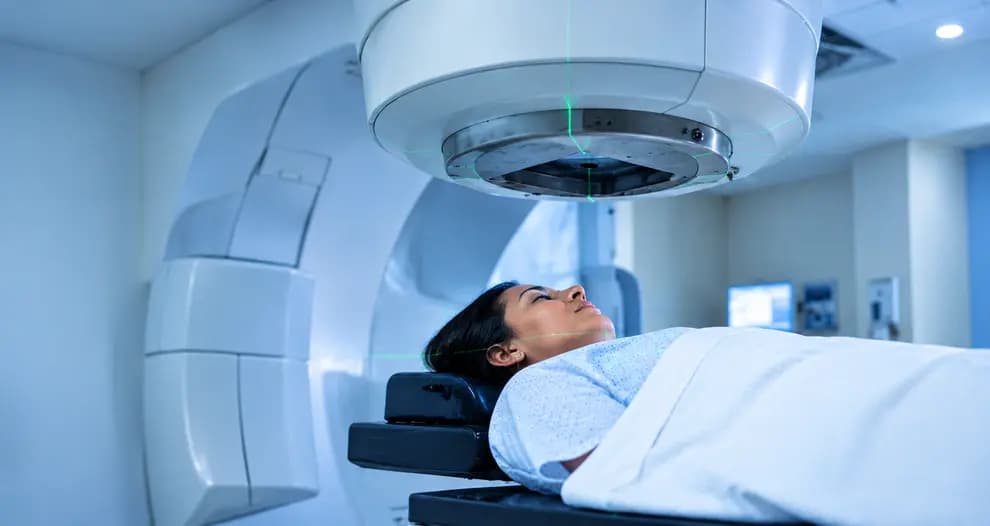
The radiation oncology department is equipped with advanced technologies, including:
-
TrueBeam Linear Accelerator: Used for external beam radiation treatments such as IGRT, IMRT, and VMAT. Image guidance helps confirm patient positioning before treatment, improving accuracy.
-
GammaMedplus iX HDR Brachytherapy System: Enables precise internal radiation delivery by controlling the movement and duration of the radioactive source within the applicator, allowing targeted tumour treatment.
-
Discovery IQ PET-CT: Helps with accurate staging and treatment planning by combining functional and anatomical imaging.
-
Da Vinci X Robotic Surgery: Supports minimally invasive cancer surgeries that may be part of treatment pathways for selected patients.
The clinical team includes radiation oncologists, medical physicists, radiation therapists, and oncology nurses experienced in complex radiation procedures. The department is led by Prof. Dr. P. R. Sasindran, with expertise in techniques including HDR brachytherapy, VMAT, IMRT, and IGRT.
With multidisciplinary services and cancer screening programmes, NAVA Cancer Institute supports patients through different stages of cancer care, from diagnosis and treatment planning to advanced radiation therapy.
Starting brachytherapy can bring several questions about the procedure, planning, safety, and expected outcomes. Having an open discussion with your radiation oncologist helps you understand your personalised treatment plan and make informed decisions.
Our team at NAVA Cancer Institute, Baby Memorial Hospital, is available to help you understand your options before you make any decision. Chat with our medical assistant today. You can Chat in Malayalam, Hindi, and English. International patients: please mention your country for dedicated support.
What to Ask Your Radiation Oncologist Before Starting Brachytherapy
Before beginning treatment, consider discussing these important points with your cancer care team:
1. Will I need brachytherapy alone, or will it be combined with external beam radiation? Ask about the treatment sequence and why that approach is recommended for your cancer type.
2. How will my brachytherapy be planned? Understand whether the centre uses traditional 2D planning or modern 3D image-guided brachytherapy using CT or MRI.
3. How many treatment sessions will I need? Ask about the number of fractions, the gap between sessions, and how long each appointment may take.
4. What happens during applicator placement? Discuss whether anaesthesia or sedation is required and whether the procedure is done as an outpatient or requires admission.
5. What side effects should I expect? Ask about possible short-term and long-term effects specific to your cancer location and how they can be managed.
6. Who reviews my treatment plan? A dedicated medical physicist plays an important role in ensuring accurate radiation delivery.
7. Are there clinical trials or additional support options available? Understanding all available choices can help you feel more prepared throughout your treatment journey.
Conclusion
Brachytherapy is not a last resort, for many cancers, it is an essential part of standard treatment. Choosing the right radiation oncologist, planning approach, and cancer centre can significantly influence treatment quality and outcomes. For patients across North Kerala, NAVA Cancer Institute at Baby Memorial Hospital brings advanced radiation oncology expertise and technology closer to home. If you or your family member has been advised radiation therapy, consult an experienced radiation oncologist to understand your options, treatment plan, and expected outcomes.
Schedule a consultation with NAVA Cancer Institute to discuss your personalised cancer care journey.