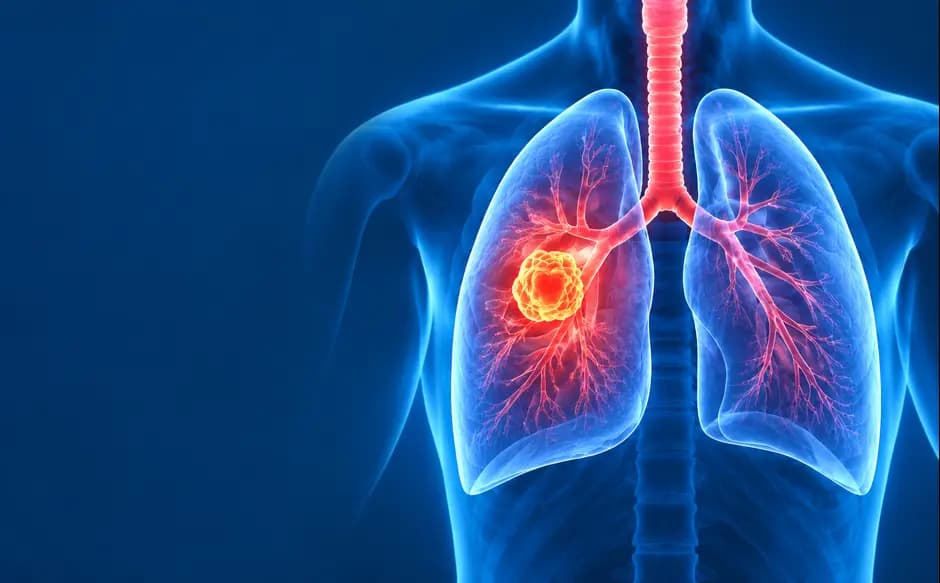

Lung cancer is broadly classified into two main types: non-small cell lung cancer (NSCLC) and small cell lung cancer (SCLC). According to the World Health Organization, approximately 85% of all lung cancers are non-small cell type, while 10-15% are small cell type. Understanding which type you or a loved one has is essential because each behaves differently, grows at different rates, and responds to different treatments.
This guide explains the fundamental differences, helping you have more informed conversations with your oncology team.
Lung Cancer: One Name, Two Very Different Diseases
Lung cancer isn't one disease, it's a family of cancers named for how their cells look under a microscope. More than 95% of primary lung cancers fall into one of two broad histological groups: non-small cell lung cancer and small cell lung cancer. NSCLC is further split into three main subtypes, adenocarcinoma, squamous cell carcinoma, and large cell carcinoma, while SCLC is usually described using a two-stage clinical system rather than the TNM framework used for NSCLC.
The two groups don't just look different under the microscope; they grow differently, spread differently, and respond to different treatment strategies, which is why identifying the correct histological subtype at diagnosis matters as much as knowing the lung cancer stage.
What Is Non-Small Cell Lung Cancer (NSCLC)?
NSCLC is the umbrella term for lung cancers whose cells appear larger and more varied under the microscope, in contrast with the small, densely packed cells of SCLC.
It tends to grow and spread more slowly, which means it is more often, though not always, caught while still confined to the lung.
The Three NSCLC Subtypes
-
Adenocarcinoma: The most common form worldwide, arising in the mucus-producing cells toward the outer edges of the lung. It's also the most frequent lung cancer diagnosed in people who have never smoked.
-
Squamous cell carcinoma: Develops in the flat cells lining the larger airways closer to the centre of the chest, and is more strongly linked to a long smoking history.
-
Large cell carcinoma: The least common subtype, undifferentiated under the microscope, and can grow quickly wherever it occurs in the lung.
How NSCLC Is Staged
Because NSCLC is staged using the standard TNM (tumour–node–metastasis) system, Stage I through Stage IV, early detection genuinely changes what's possible. A tumour caught at Stage I, confined to the lung, can often be treated with surgery alone, whereas Stage IV disease (spread beyond the chest) is managed as a systemic illness with drugs rather than an operation.
What Is Small Cell Lung Cancer (SCLC)?
SCLC gets its name from how its cells look under a microscope, small, round, and tightly packed, once described as resembling grains of oats (hence the older term "oat cell carcinoma").
Nearly everyone diagnosed with SCLC has a significant smoking history; it is rare in people who have never smoked.
Limited-Stage vs Extensive-Stage SCLC
Instead of the TNM system, oncologists typically classify SCLC as limited-stage (confined to one side of the chest, within a single radiation field) or extensive-stage (spread beyond that, including to the other lung, distant organs, or through the bloodstream). SCLC also tends to double in size faster than NSCLC and is often already present at multiple sites by the time it's diagnosed, which is why surgery is rarely the first option and chemotherapy usually begins promptly.
Paraneoplastic Syndromes Linked to SCLC
SCLC is also associated with a group of paraneoplastic syndromes, conditions caused indirectly by hormone-like substances the tumour releases, such as low blood sodium (SIADH) or muscle weakness (Lambert-Eaton syndrome), that can sometimes appear before the lung tumour itself causes symptoms.
Non-Small Cell vs Small Cell Lung Cancer: Side-by-Side Comparison
Although both are lung cancers, NSCLC and SCLC differ in how they develop, spread, and respond to treatment. The table below highlights the key differences at a glance.
| Feature | Non-Small Cell Lung Cancer (NSCLC) | Small Cell Lung Cancer (SCLC) |
|---|---|---|
| Share of all lung cancers | ~80–85% | ~10–15% |
| Cell appearance under microscope | Larger, more varied cells | Small, round, densely packed cells |
| Main subtypes | Adenocarcinoma, squamous cell carcinoma, large cell carcinoma | Small cell carcinoma, combined small cell carcinoma |
| Growth pattern | Generally slower-growing | Fast-growing and quick to spread |
| Staging system used | TNM system (Stage I–IV) | Limited-stage or extensive-stage |
| Link to smoking | Strong, but ~10–20% occur in never-smokers (mainly adenocarcinoma) | Very strong; rare in people who have never smoked |
| First-line treatment (early disease) | Surgery (lobectomy), or SBRT if inoperable | Combined chemotherapy + radiation, even at limited stage |
| Typical stage at diagnosis | More often found earlier, though still frequently advanced | About 2 in 3 cases already extensive-stage at diagnosis |
| Role of biomarker/targeted therapy | Central — EGFR, ALK, ROS1, PD-L1 testing routinely guides treatment | Limited; immunotherapy now added to chemotherapy in extensive-stage disease |


Symptoms: Where They Overlap and Where They Differ
Both types can cause the same initial warning signs, a persistent cough, coughing up blood, unexplained weight loss, chest pain, shortness of breath, and recurrent chest infections. Because early-stage lung cancer is frequently silent, symptoms in both types often appear only once the tumour is sizeable or has begun to spread.
Where the two tend to diverge is in extras caused by the biology of the tumour itself. SCLC's paraneoplastic syndromes can cause symptoms unrelated to the lungs, confusion from low sodium, or facial and arm swelling from superior vena cava obstruction, when a fast-growing tumour compresses the large vein returning blood to the heart.
NSCLC symptoms are more often confined to the respiratory system unless the disease has already spread to bone, brain, or liver, which typically happens later in its course than it does with SCLC.
How Doctors Diagnose and Differentiate NSCLC from SCLC
The distinction is never made from a scan alone, it requires a tissue biopsy examined by a pathologist, sometimes supported by immunohistochemistry stains that highlight specific proteins.
Immunohistochemistry Markers
- TTF-1 and napsin A typically point to adenocarcinoma
- p40 or p63 point to squamous cell carcinoma
- Synaptophysin, chromogranin A, and CD56 support a diagnosis of small cell carcinoma
Biomarker & Molecular Testing in NSCLC
For NSCLC, diagnosis doesn't stop at the subtype. Because targeted drugs and immunotherapy now play a major role in treatment, the biopsy sample is usually tested for actionable mutations, EGFR, ALK, ROS1, and KRAS, and for PD-L1 expression, which helps predict how well a tumour will respond to immunotherapy.
This molecular work-up is one of the biggest practical differences between the two cancers: it rarely changes first-line treatment in SCLC, but it can completely change the treatment plan in NSCLC, sometimes replacing chemotherapy altogether with a daily targeted tablet.
Treatment Approaches: Why NSCLC and SCLC Are Managed Differently
Treatment depends heavily on the cancer type, stage, spread, and overall health. Because NSCLC and SCLC behave differently and respond differently to treatment, doctors use distinct approaches for each.
NSCLC Treatment by Stage
-
Stage I–II (localized): Surgery, usually a lobectomy, when the patient is fit enough. Stereotactic body radiotherapy (SBRT) is offered when surgery isn't suitable.
-
Stage III (locally advanced): Combined chemotherapy and radiation therapy, sometimes followed by a year of immunotherapy to lower the chance of recurrence.
-
Stage IV (metastatic): Systemic treatment, targeted therapy for tumours with an actionable mutation, immunotherapy, chemotherapy, or a combination, chosen according to biomarker results.
SCLC Treatment by Stage
-
Limited-stage: Combined chemotherapy and radiation given together, sometimes followed by preventive radiation to the brain, because SCLC has a notable tendency to spread there even before it causes symptoms.
-
Extensive-stage: Chemotherapy combined with immunotherapy (such as durvalumab or atezolizumab) is now standard first-line treatment, a meaningful shift in SCLC care over the past several years.
Surgery is uncommon in SCLC and is generally reserved for the rare case where a very small tumour is discovered before it has had the chance to spread.
Get the Right Lung Cancer Diagnosis at NAVA Cancer Institute
A suspected lung cancer diagnosis can raise an immediate question: is it non-small cell lung cancer (NSCLC) or small cell lung cancer (SCLC), and what does that mean for treatment? Getting that distinction right requires more than a single test or specialist opinion.
At NAVA Cancer Institute, Baby Memorial Hospital, Kozhikode, lung cancer evaluation brings multiple specialties together, including medical oncology, surgical oncology, radiation oncology, pulmonology and nuclear medicine. Depending on the case, investigations may include:
- Bronchoscopy, EBUS or thoracoscopy for tissue sampling
- Imaging and PET-CT to determine the extent of disease
- Pathology and molecular testing to identify the cancer subtype and relevant biomarkers
- Multidisciplinary tumour board review to coordinate treatment planning
Once the diagnosis and stage are established, the team can determine whether surgery, chemotherapy, immunotherapy, targeted therapy, radiation or a combination of treatments is appropriate.
For patients in North Kerala, having these specialists and diagnostic facilities within one cancer centre can simplify the process from biopsy to staging and treatment planning. A second opinion may also be worthwhile when the diagnosis or treatment approach is unclear.
Conclusion
Non-small cell and small cell lung cancer share a name and, often, an initial set of symptoms, but from the moment a pathologist looks under the microscope, they follow separate paths. NSCLC's three subtypes are staged with the standard TNM system and increasingly treated with mutation-specific drugs; SCLC grows faster, is staged as limited or extensive, and is managed with prompt chemotherapy and radiation.
What both share, especially in India, is that outcomes hinge heavily on how early the diagnosis is made, which is exactly why any new, persistent respiratory symptom deserves a proper work-up rather than a wait-and-see approach.
If you're weighing a lung cancer diagnosis for yourself or a loved one, getting the histological subtype confirmed and discussed by a multidisciplinary team is the single most useful first step you can take.
Chat with our assistant on Whatsapp to get a second opinion, or to request a call back from the NAVA Cancer Institute team.
Medical Disclaimer: This article is for general informational purposes only and is not a substitute for professional medical advice, diagnosis, or treatment. Always seek the guidance of a qualified physician or oncologist with any questions you may have regarding a medical condition. Never disregard professional medical advice or delay seeking it because of something you have read here.