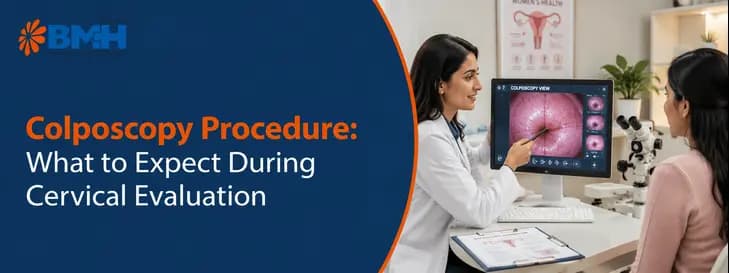

When a Pap smear or HPV test comes back "abnormal," the next word a gynaecologist usually says is colposcopy and for most people, that word lands with a jolt of anxiety before any explanation follows. It shouldn't. A colposcopy is one of the simplest, lowest-risk diagnostic procedures in gynaecology, and knowing exactly what happens, step by step, tends to make the actual appointment far less stressful than the days spent waiting for it.
Colposcopy is a focused examination of the cervix using a magnifying instrument called a colposcope. This guide walks through the colposcopy procedure in the order it actually happens, preparation, the exam itself, biopsy, recovery, and what the results mean, along with what it typically costs in India and when to seek a specialist opinion.
What Is a Colposcopy, and Why Does It Matter?
A colposcopy is a diagnostic examination that gives a doctor a magnified, well-lit view of the cervix, vagina and vulva using an instrument called a colposcope. Despite the name, the colposcope is not inserted into the body at any point, it sits outside the vaginal opening, functioning much like a lighted, standing magnifying binocular.
The magnification (typically 10–40x) lets a clinician see cell-level changes on the cervix that are completely invisible during a standard pelvic exam. A colposcopy itself is diagnostic, not curative, it doesn't treat anything.
Its job is to answer one question precisely: is there an area on the cervix, vagina or vulva that needs a biopsy to rule out precancer or cancer?
Colposcopy vs Pap Smear vs HPV Test
These three terms are often confused because they're used in sequence, but each does a different job:
| Test | What it does | When it's used |
|---|---|---|
| Pap smear | Screens cervical cells under a microscope for early changes | Routine screening every 3 years (or per your doctor's schedule) |
| HPV test | Checks for high-risk HPV strains that cause most cervical cancers | Often paired with a Pap smear from age 30 onward |
| Colposcopy | Gives a magnified, direct view of the cervix to locate and biopsy suspicious areas | Ordered only after an abnormal Pap or HPV result, or an abnormal-looking cervix |
Why Would a Doctor Recommend a Colposcopy?
A colposcopy isn't a first-line test, it's a follow-up step. Common reasons a gynaecologist orders one include:
- An abnormal Pap smear result (ASC-US, LSIL, HSIL, or atypical glandular cells)
- A positive high-risk HPV test, particularly HPV-16 or HPV-18
- A cervix that looks visibly abnormal during a routine pelvic exam
- Unexplained bleeding after intercourse, between periods, or after menopause
- Persistent, unusual vaginal discharge with no clear cause
It's worth repeating what most gynaecologists tell first-time patients: a large share of people who get a colposcopy after an abnormal Pap or HPV result turn out to have normal findings, or only minor changes that resolve on their own. A colposcopy referral is a step of caution, not a diagnosis.
Also Read: How Is Cervical Cancer Detected? Tests & Screening Guide


How to Prepare for a Colposcopy
Preparation for a colposcopy is minimal compared to most diagnostic procedures, there's no fasting, sedation planning, or special diet involved. A few practical steps do make the exam more accurate and comfortable:
- Schedule it for a week when you are not menstruating, since heavy bleeding can obscure the view.
- Avoid vaginal creams, suppositories, tampons and douching for 24–48 hours beforehand.
- Avoid vaginal intercourse for about 48 hours before the appointment.
- Take a mild over-the-counter pain reliever (such as ibuprofen or paracetamol) about 30–60 minutes before your appointment if you tend to have cramping with pelvic exams.
- Tell your doctor if there's any chance you could be pregnant, colposcopy is generally safe in pregnancy, but your doctor will adjust the approach to biopsy if needed.
Wearing comfortable clothing and bringing a sanitary pad for afterward (in case a biopsy is taken) are small details that make the visit smoother.
Is a Colposcopy Painful?
For most patients, a colposcopy without biopsy feels similar to a Pap smear, mostly pressure, with a brief sting when the acetic acid solution is applied. The exam can be uncomfortable and may cause a feeling of pressure, but it should not be painful. If a biopsy is taken, the sensation is usually described as a sharp pinch or a cramp, similar to strong period pain, and lasts only a few seconds per sample.
Anxiety tends to amplify discomfort more than the procedure itself does. Slow breathing, relaxing the pelvic floor rather than tensing it, and asking your doctor to narrate each step before it happens all measurably reduce perceived pain during colposcopy.
For patients who are especially anxious or have a low pain threshold, some hospitals, including BMH, offer a local anaesthetic injection or spray before biopsy, which is worth asking about at the time of booking
Recovery After a Colposcopy
Recovery depends on whether a biopsy was performed:
| No biopsy taken | Biopsy taken | |
|---|---|---|
| Return to activity | Immediately, no restrictions | Usually within a day, avoiding strenuous exercise for 1–2 days |
| Spotting/discharge | Rare, minimal | Mild spotting or dark discharge for 2–5 days is normal |
| Intercourse | No restriction | Avoid for about a week, or as your doctor advises |
| Tampons/douching | No restriction | Avoid until fully healed; use pads instead |
| Pain relief | Not usually needed | Mild OTC pain relievers (ibuprofen/paracetamol) as needed |
Contact your doctor promptly if you notice heavy bleeding (soaking a pad within an hour), fever, severe pelvic pain, or foul-smelling discharge after the procedure, these are uncommon but warrant a same-day call.
Understanding Your Colposcopy Results
Colposcopy and biopsy results are generally reported using the CIN (Cervical Intraepithelial Neoplasia) grading system when abnormal cells are found:
| Result | What it means | Typical next step |
|---|---|---|
| Normal | No abnormal cells found | Return to routine Pap/HPV screening schedule |
| CIN 1 (low-grade) | Mild cell changes, often caused by HPV that the body clears on its own | Monitoring with repeat testing in 6–12 months |
| CIN 2–3 (high-grade) | Moderate-to-severe precancerous changes | Treatment such as LEEP (loop electrosurgical excision) or cone biopsy |
| Cancer | Invasive cancerous cells identified | Referral to a gynaecologic oncology team for staging and treatment planning |
Is Colposcopy Safe? Risks to Know
Colposcopy is considered a low-risk, minor procedure. Reported complications are uncommon and generally minor:
- Light bleeding or spotting for a few days after biopsy
- Mild cramping, similar to period pain
- Rarely, infection at the biopsy site (signalled by fever, worsening pain, or foul discharge)
- Very rarely, heavier bleeding that needs medical attention
- There is no radiation involved, and the procedure does not affect fertility.
Why Women Across Kerala and Beyond Turn to BMH's NAVA Cancer Institute for Cervical Health
Let's talk about what actually happens after an abnormal colposcopy result, because that's usually the part patients worry about most not the procedure itself, but what comes next if something is found.
At Baby Memorial Hospital (BMH) in Kozhikode, colposcopy and cervical biopsy are handled within the Obstetrics & Gynaecology department, but any abnormal, high-grade finding is reviewed jointly with the NAVA Cancer Institute, BMH's dedicated cancer centre that brings together surgical, medical, radiation, and gynaecologic oncology under one roof.
That structure matters practically: a patient doesn't need a separate referral, a second round of tests at another facility, or a delay while records are transferred between hospitals. The same diagnostic pathway that starts with a colposcopy can lead directly into a tumour-board discussion if it's needed.
BMH's NAVAyug Cancer Screening package for women bundles Pap and HPV testing, imaging, and gynaecology/oncology consultation into a single visit, designed specifically for the reality that many women delay screening simply because it means multiple appointments across different departments.
BMH also treats a meaningful volume of patients travelling from outside Kozhikode, from other districts in Kerala, from neighbouring states, and internationally, particularly from the Gulf.
For these patients, the hospital's dedicated case management and multilingual support exist specifically to reduce the friction of coordinating care from a distance, while keeping treatment costs within a range that's realistic for both domestic and international budgets compared to many metro-city cancer centres.
None of this changes what a colposcopy itself involves, the procedure is the same wherever it's done. What it does affect is what happens if your result isn't normal: how quickly you're seen by the right specialist, how many times you have to repeat your story and your scans, and how coordinated that next step feels when it matters most.
You can chat with our medical assistant for quick answers about colposcopy, screening packages, or appointment booking
Medical Disclaimer: This article is for general informational purposes only and is not a substitute for professional medical advice, diagnosis, or treatment. Always consult a qualified gynaecologist or oncologist regarding your specific symptoms, test results, or treatment options. Cost figures are indicative estimates compiled from publicly available sources and may vary by hospital, city, and individual case.